
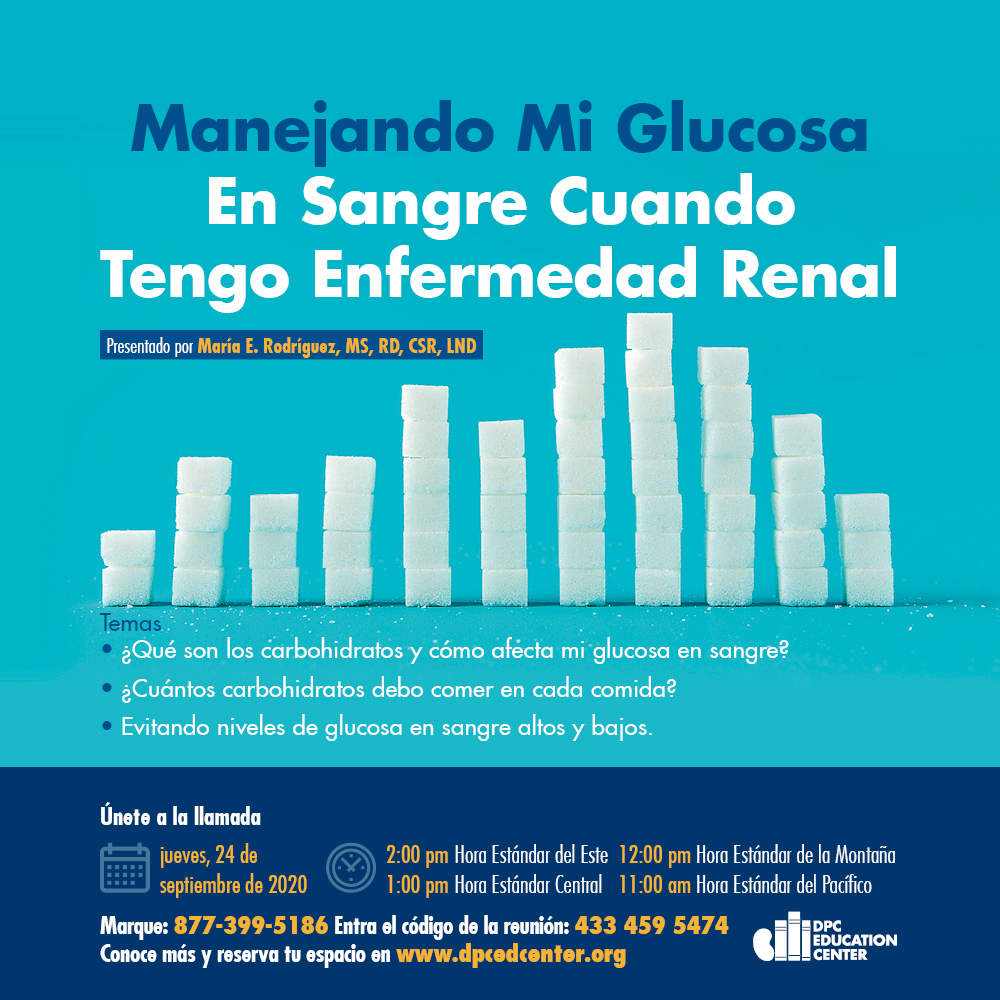
Manejando Mi Glucosa En Sangre Cuando Tengo Enfermedad Renal
Temas: 1) ¿Qué son los carbohidratos y cómo afecta mi glucosa en sangre?, 2) ¿Cuántos carbohidratos debo comer en cada comida?, 3) Evitando niveles de glucosa en sangre altos y bajos.

Hannah Bracamonte2024-03-28T20:59:55-04:00August 28th, 2020|Categories: Nutrition, Spanish Materials, Webinar|
Temas: 1) ¿Qué son los carbohidratos y cómo afecta mi glucosa en sangre?, 2) ¿Cuántos carbohidratos debo comer en cada comida?, 3) Evitando niveles de glucosa en sangre altos y bajos.

Hannah Bracamonte2024-03-28T20:59:56-04:00August 21st, 2020|Categories: Additional Resources, Early Intervention, eNews, Home Hemodialysis, In-Center Hemodialysis, Kidney Transplant, Peritoneal Dialysis, Treatment, Webinar|
New medical treatments and products are continually being developed for people living with kidney disease. Part of the development process for high quality, scientific, and safe options is through research to test the treatment or product before it becomes available on the market. This phase of research is called a clinical trial or a clinical research project. People can volunteer to be part of a clinical trial if they meet the specific requirements for the study. You might consider participating in the research process for many reasons including if it has a personal meaning for you or if you want to [...]

Hannah Bracamonte2024-03-28T20:59:57-04:00August 18th, 2020|Categories: Additional Resources, Lifestyle, Mental Health, Physical Health, Stress Management, Support, Webinar|Tags: COVID-19|
During this webinar, Dr. Christofferson will offer advice on how to deal with feelings of fear, isolation, anxiety and stress during the coronavirus outbreak.

Hannah Bracamonte2024-03-28T20:59:58-04:00August 11th, 2020|Categories: eNews, Lifestyle|Tags: COVID-19|
As officials across the country make decisions on how to safely reopen cities amid a global pandemic, people with End-Stage Renal Disease (ESRD) must remain vigilant about taking precautions to lower their risk for COVID-19 infection. COVID-19 cases and hospitalizations increased significantly among ESRD patients from May 16 to June 20, as reported by the Centers for Medicare & Medicaid Services. The number of kidney disease patients who were diagnosed reached 3,818 per 100,000 people, while hospitalizations were reported at 1,911 per 100,000 people. These rates are more than double that of the general population during that same time frame, demonstrating [...]

Hannah Bracamonte2024-03-28T20:59:59-04:00August 5th, 2020|Categories: Costs for Treatment, eNews, Stress Management, Support|
Emergency grants can help cover costs for transportation, medication, rent and food when someone is sick. This one-page guide will help you better understand the submission process with a summary of searching, preparing, applying and tracking grants. Included is a list of documents you may be asked to submit with your grant request. Reach out to your social worker if you need help. Check out the guide.
Hannah Bracamonte2024-03-28T21:00:00-04:00July 31st, 2020|Categories: Home Hemodialysis, In-Center Hemodialysis, Webinar|
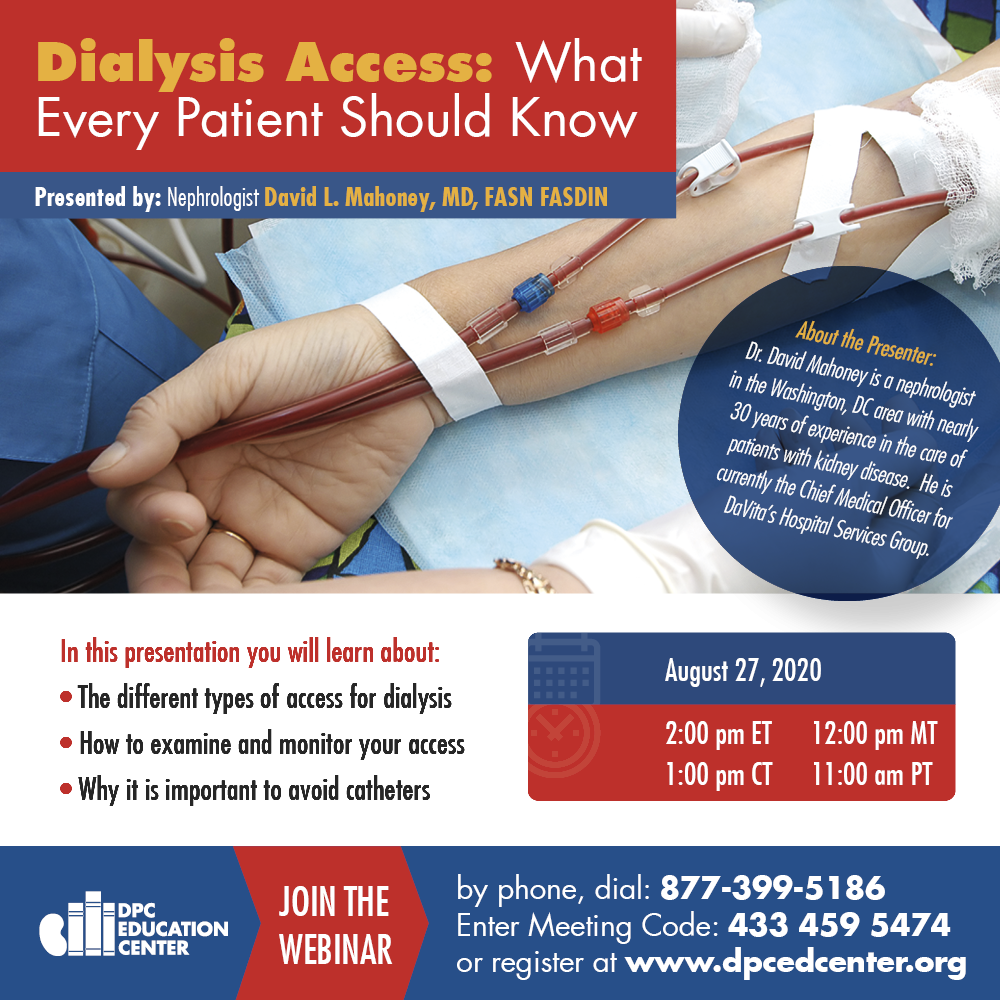
In this presentation you will learn about: 1) the different types of access for dialysis, 2) how to examine and monitor your access and 3) why it is important to avoid catheters.

Hannah Bracamonte2024-03-28T21:00:00-04:00July 20th, 2020|Categories: Lifestyle, Mental Health, Stress Management|
By Rachel Fintzy Woods, MA, MFT So many aspects of life are beyond our control. When the challenges of managing an illness such as chronic kidney disease are added to our plate, we can feel overwhelmed. Emotions such as anger, confusion, fear and sadness are common and natural, especially at the outset of our journey with illness. It can seem as if our world has been turned upside down. Yet we do have some say in how we deal with the cards we’ve been dealt, including our medical condition and life itself. We alone are responsible for our actions and our [...]

Hannah Bracamonte2024-03-28T21:00:01-04:00July 15th, 2020|Categories: eNews, Kidney Transplant|
The U.S. Public Health Service (PHS) recently released the PHS Guideline for Solid Organ Donor Assessment for Human Immunodeficiency Virus (HIV), Hepatitis B Virus (HBV), and Hepatitis C Virus (HCV) Infection and Transplant Recipient Monitoring. This document updates existing PHS guidance pertaining to solid organ donors and recipients and testing for HIV, HBV, and HCV in addition to informed consent and appropriately communicating the risk of disease transmission to transplant candidates. The revised guideline reflects substantial advances in testing technology and treatment that improve patient safety. Key things for you to know: Risk of infection due to transplant is very low. [...]

Hannah Bracamonte2024-03-28T21:00:02-04:00July 13th, 2020|Categories: Fact Sheet, Mental Health, Physical Health, The Kidney Citizen|
How Chronic Pain Can Impact Your Mental Health When You Have Kidney Disease By Hannah Calkins Chronic pain and depression are closely linked and because as many as 60 percent of hemodialysis patients report moderate to severe chronic pain, it’s likely that many of them have experienced depression—or are at risk for it. But it may not look or feel the way you expect, according to psychologist Robert Kerns, PhD. “Depression among people with chronic pain may not be experienced as profound sadness,” says Kerns, a professor of psychiatry, neurology and psychology at Yale University. “Other symptoms may be more likely [...]

Hannah Bracamonte2024-03-28T21:00:03-04:00July 6th, 2020|Categories: Diagnosis of Kidney Disease, In-Center Hemodialysis, The Kidney Citizen|Tags: Advocacy, Patient Perspective|
By Gloria Rohrer, DPC Patient Ambassador As a dialysis patient, it has become clear to me that one of the biggest flaws in the American health care system is the disjointed way care is often provided to patients. If patients have chronic conditions alongside other health complications, it can be exceedingly difficult to navigate the different doctors and hospitals we need in order to receive proper care. When seeing so many different doctors at various clinics and hospitals, patients like me can suffer adverse effects if all our treatments are not designed to address our full medical history, rather than a [...]
1001 Connecticut Avenue, NW, Suite 1230 Washington, DC 20036
Phone: 1-855-291-3725
Fax: 1-888-423-5002
Email: info@dpcedcenter.org